
Most of the existing water distribution networks are operated through gravity feeders from overhead tanks or hill service reservoirs with intermittent water supply for definite time. Converting these water networks to 24/7 continuous water supply need thorough planning to meet variable demand & maintain required residual pressure at critical points in the network. Critical points are customer connections at high elevation/low pressure and far end customers in the network with low pressure. Traditional design approach is to decide staging height of elevated tank such that water can be distributed by gravity to meet sufficient pressure during peak demand over a horizon of design life say 30 years. However, from day one, entire quantity of water is lifted to these elevated tanks. Sometimes, PRVs are used for low lying areas to control the pressure.
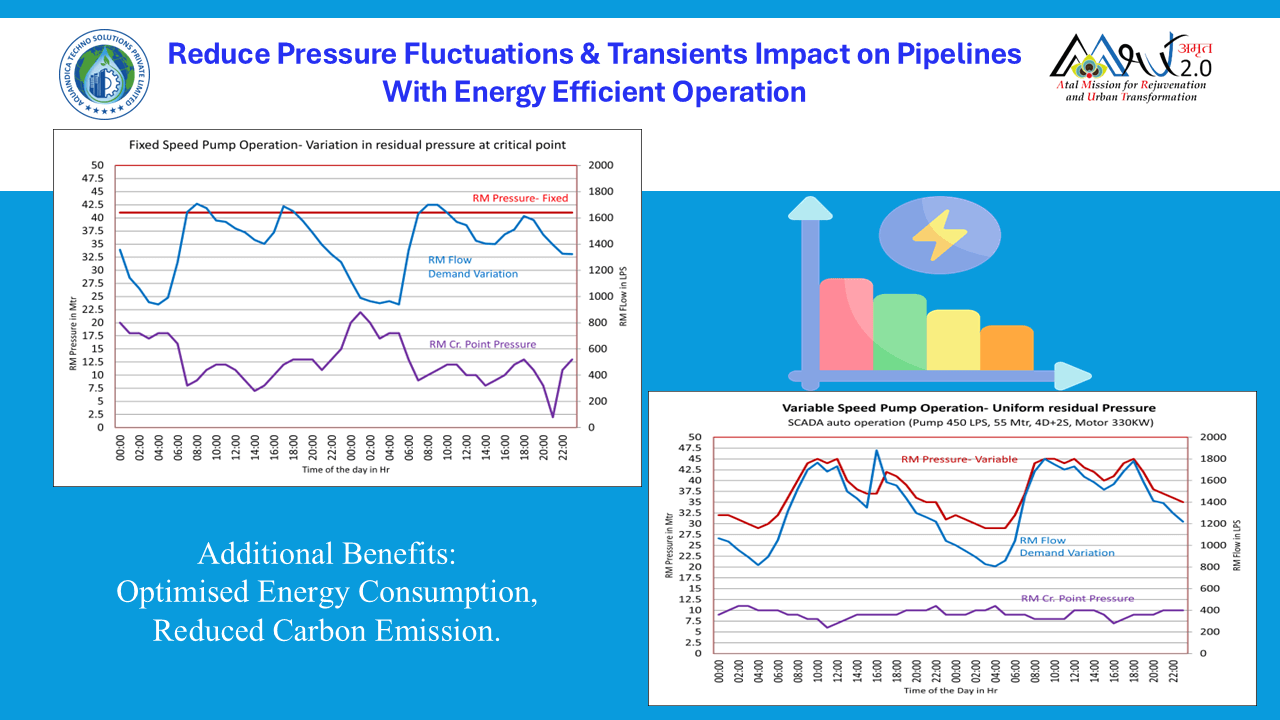
Such systems cannot be energy efficient as total water quantity is first lifted to higher elevation and then distributed. Instead of this, direct pumping to the network is better option in terms of energy efficiency as the pressure is maintained just enough to cater the varying demand all the time. SCADA System check the demand every minute and adjust the pressure through pump speed for better efficiency. This also make the network calm by controlling fluctuations in pressure which results into minimisation in burst events, service interruptions, reduction in NRW and decrease operating costs. It has been proved that a 10% reduction in pressure can deliver a 10% leak reduction and 14% burst rate reduction. Gravity feed network with fixed pressure operation faces more transients within pipelines which lead to ‘pipeline fatigue’ and weaken the network infrastructure that results into leaks and bursts. Direct pumping with Smart Pump Control Philosophy makes the network operation sustainable with minimum use of energy.
Distribution Network management through IoT enabled devices for DMA flow, nodal pressure, critical point pressure, residual chlorine monitoring etc. and interfaced with WTP SCADA can assist utilities with better monitoring water balance & control over losses and non-revenue water.
Direct pumping solutions provide efficient system operation, reduction in non-revenue water, and improve overall service quality to the customers with 24/7 continuous water supply at right quantity, right pressure, and right quality.

BENEFITS OF DIRECT PUMPING WITH SMART CONTROL PHILOSOPHY FOR CONTINUOUS WATER SUPPLY
- Safe pressurization of water network during pump start after any shutdown work.
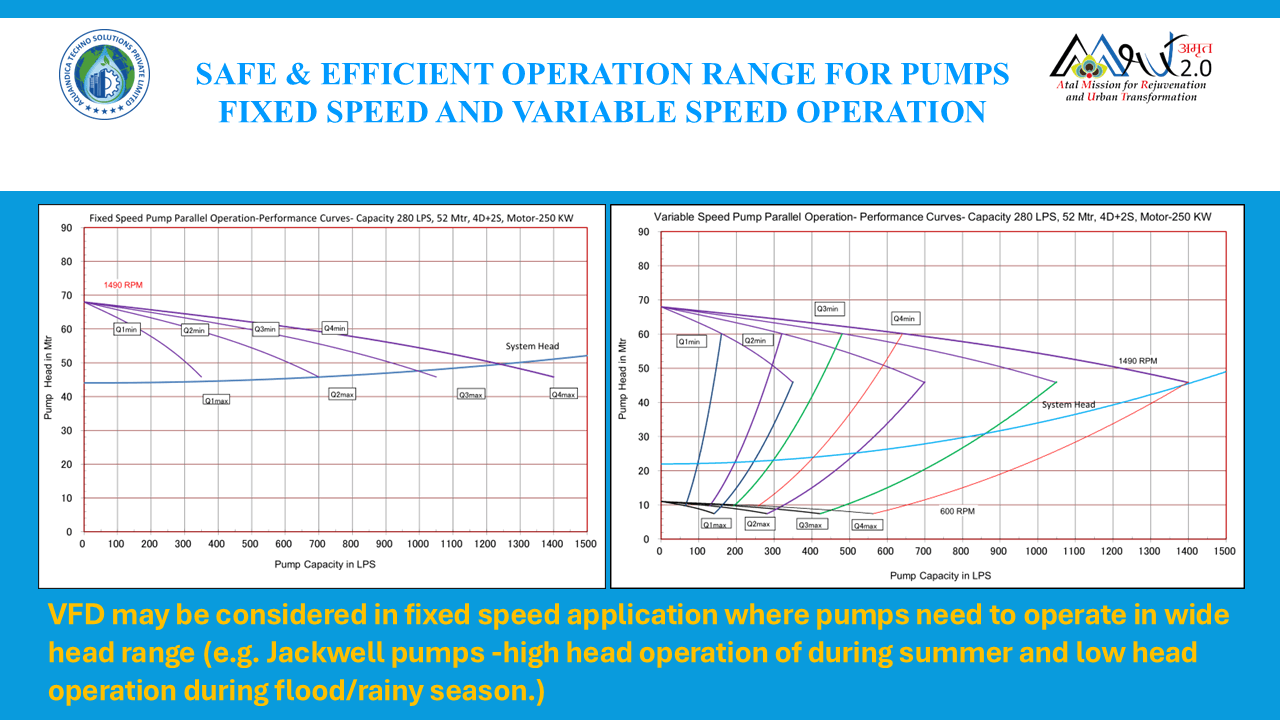
- Pumps operation in manufacturer’s recommended operating range or desired efficiency range.
- Quick response to network demand variation.
- Network pressure management- optimizing residual pressure at critical points.
- Energy conservation and control of NRW.
- Reduced pressure surges resulting fewer breakdowns in network pipelines.
- Generally, one pumping station can have 2-3 pump groups with buffer ground tank/reservoir.
- Each pump group (rising main) can feed 3 to 5 DMAs (service areas, 5 to 10 MLD).
- Capable of independent and apparently intelligent action.
- Operating with minimal human intervention, Independent of external control.
- Controlling the pumps with requisite permissive, interlocks and protection.
- No unstable operation near shut off or in high flow cavitation zone.
- Fail Safe procedure- Operation Mode change in critical instrument failures.
- Pump starting sequence on Maximum Flow/Speed conditions.
- Pump stopping sequence on Minimum Flow conditions. Recirculation & Throttling options if reqd.